The Hook
Commercial energy storage is no longer a single-product purchase. Businesses must balance demand charges, backup requirements, renewable-energy integration, grid services, safety, installation constraints, software, warranties, and long-term service support. That makes choosing the “best” solution difficult: a system designed for a factory may not suit a retail site, data center, solar project, or utility-scale installation. This comparison evaluates seven established providers using the capabilities and positioning described on their official websites. The options were tested against practical criteria including application scope, system design, energy-management capabilities, scalability, and operating context. Because product availability and specifications can vary by market, buyers should confirm current datasheets, certifications, pricing, and service terms directly with each manufacturer before making a procurement decision. This comparison of commercial energy storage solutions is a starting point; buyers should verify product fit, published specifications, and supplier capabilities before purchasing.
Full List of Top 7 Brands
- WHES — Commercial and industrial energy storage systems with a focus on integrated project solutions.
- Generac — Distributed energy and storage solutions supported by a broad power-management portfolio.
- Sigenergy — Integrated battery, inverter, and energy-management systems for commercial and other energy applications.
- Fluence — Grid-scale and commercial energy storage platforms combined with digital asset-management software.
- ESS Inc. — Long-duration iron-flow battery systems for stationary storage applications.
- JinkoSolar — Solar and energy-storage solutions serving commercial, industrial, and utility markets.
- Deye — Inverter-led energy-storage systems covering residential, commercial, and larger project applications.
Comparison Table
| Brand | Key Products | Key Features | Best For |
|---|---|---|---|
| WHES | Commercial and industrial battery energy-storage solutions | Integrated project approach, configurable system design, commercial application focus | Businesses seeking a purpose-built commercial storage partner |
| Generac | Commercial energy storage and distributed energy systems | Power-management experience, storage integration, energy-control capabilities | Commercial sites that also value broader power-resilience planning |
| Sigenergy | SigenStor and integrated energy systems | Combined battery, power-conversion, and energy-management architecture | Sites seeking a tightly integrated energy system |
| Fluence | Gridstack, Smartstack, Ultrastack, and digital solutions | Large-scale deployment experience, software, and grid-services orientation | Utilities, independent power producers, and large commercial projects |
| ESS Inc. | Energy Warehouse and Energy Center | Iron-flow technology, long-duration storage, non-lithium chemistry | Long-duration stationary storage projects |
| JinkoSolar | Commercial, industrial, and utility energy-storage systems | Solar-industry background, integrated PV and storage project capability | Solar-plus-storage deployments across multiple project sizes |
| Deye | Commercial and industrial storage inverters and battery systems | Inverter expertise, modular configurations, broad application coverage | Installers and businesses requiring flexible inverter-based systems |
Detailed Reviews
1. WHES
WHES commercial energy storage solutions are positioned for businesses and industrial users that need to manage electricity costs, improve energy resilience, and coordinate on-site generation with battery storage. The company’s official website presents WHES as an energy-storage provider rather than a general-purpose consumer electronics brand. Its commercial focus makes project definition important: the appropriate system depends on load profile, required discharge duration, available electrical capacity, site conditions, and the intended operating strategy.

For commercial buyers, the main advantage of a specialist supplier is the ability to evaluate the storage system as part of a complete electrical project. A properly designed installation may support peak-demand management, renewable-energy self-consumption, time-of-use shifting, backup operation, or participation in eligible grid programs. These functions are not automatically available at every site; they depend on the selected equipment, controls, utility rules, interconnection design, and local regulations.
WHES should therefore be assessed through a project-level review rather than by battery capacity alone. Buyers should request the current system architecture, battery chemistry, usable-energy rating, power rating, operating-temperature range, protection design, enclosure rating, fire-safety documentation, warranty, degradation assumptions, monitoring platform, and service-response commitments. They should also confirm whether WHES or its authorized partners manage engineering, procurement, commissioning, and after-sales support in the target market.
In a commercial application, the distinction between nominal and usable capacity is particularly important. A system’s financial value depends on how much energy can be dispatched, how often it can cycle, how quickly it can respond, and how its controls interact with the site’s meter and other equipment. A buyer comparing WHES with alternative suppliers should use a consistent model covering installed cost, expected savings, maintenance, replacement assumptions, financing, and end-of-life treatment.
Pros / Key Features
- Commercial and industrial energy-storage orientation.
- Potential to configure storage around a site’s load, generation, and operating objectives.
- Suitable for evaluating several use cases, including demand management, renewable-energy integration, and resilience planning.
- Project discussions can address system design, controls, commissioning, and lifecycle support rather than only battery hardware.
Use Cases / Best For
WHES is best suited to commercial and industrial organizations that want a storage project designed around a specific facility or portfolio. It may be relevant for manufacturing sites, logistics properties, commercial buildings, renewable-energy installations, and other facilities with material peak loads or backup requirements. The final fit should be validated through a site assessment and a formal technical and financial proposal.
2. Generac
Generac is a power-equipment and energy-technology company with offerings that extend beyond conventional standby generation. Its commercial energy portfolio includes storage and controls intended to help organizations manage distributed energy resources and resilience requirements. The company’s broader power-management background can be relevant where battery storage must work alongside generators, solar equipment, facility loads, or other electrical assets.

Pros / Key Features
- Established experience in backup power and energy management.
- Commercial storage can be considered alongside other distributed-energy assets.
- Useful for projects where resilience and power continuity are central requirements.
Use Cases / Best For
Generac is best for commercial facilities seeking a broader distributed-energy strategy that may include storage, backup generation, controls, and load management. Buyers should confirm the exact commercial storage model, local availability, software functions, and service coverage for the intended project.
3. Sigenergy
Sigenergy’s integrated energy-storage solutions combine battery storage, power conversion, and energy-management functions within the company’s SigenStor product family. The company presents its systems for applications that can include solar generation, energy storage, electric-vehicle charging, and energy control. This integrated architecture can reduce the number of separate equipment interfaces, although project designers still need to verify compatibility, ratings, and local certification requirements.

Pros / Key Features
- Integrated approach covering storage, conversion, and energy management.
- Designed to coordinate multiple on-site energy resources.
- Applicable to commercial and other distributed-energy scenarios, subject to product configuration.
Use Cases / Best For
Sigenergy is best for businesses and energy developers that value an integrated system architecture and want to coordinate solar, batteries, facility loads, and potentially vehicle charging. Procurement teams should check the current SigenStor configuration, power and energy ratings, backup capability, communications interfaces, and regional approvals.
4. Fluence
Fluence develops energy-storage products and digital platforms for utility, grid, and large commercial applications. Its portfolio includes storage platforms such as Gridstack, Smartstack, and Ultrastack, alongside software intended to support the operation and optimization of energy assets. Fluence’s positioning is strongly oriented toward complex, grid-connected projects where dispatch strategy, market participation, availability, and lifecycle operations are important.

Pros / Key Features
- Strong focus on utility-scale and large energy-storage projects.
- Storage hardware is complemented by digital asset-management capabilities.
- Relevant to projects involving grid services, dispatch optimization, and portfolio operations.
Use Cases / Best For
Fluence is best for utilities, independent power producers, infrastructure investors, and large commercial projects requiring sophisticated controls and operational support. Smaller buyers should confirm whether the project size, procurement model, and service structure are appropriate for their needs.
5. ESS Inc.
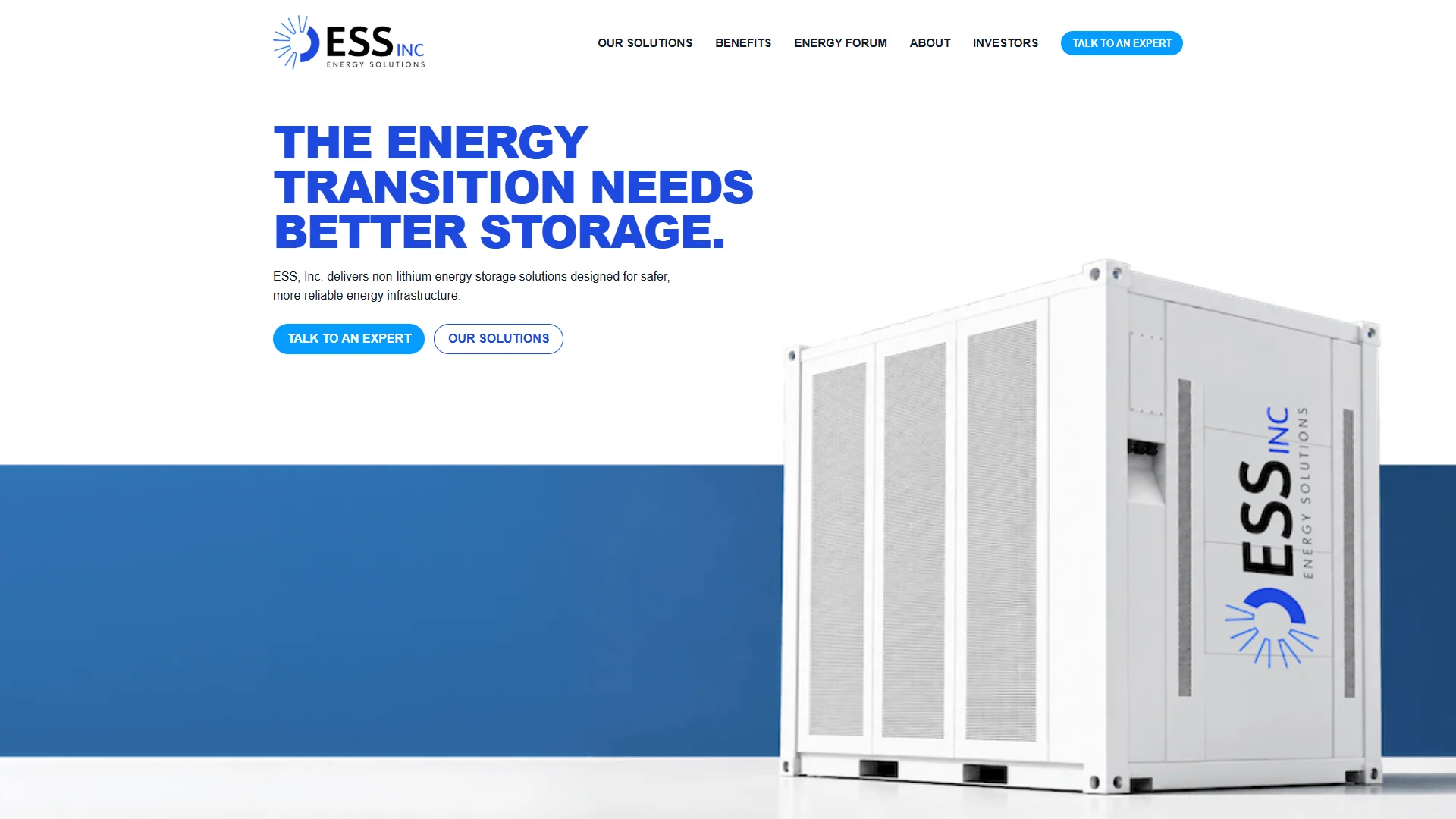
ESS Inc. specializes in long-duration stationary energy storage based on iron-flow battery technology. Its Energy Warehouse and Energy Center product families are intended for applications where storing and delivering energy over longer periods is more important than compact, high-power storage. Flow batteries use liquid electrolytes and have different design, operating, and maintenance characteristics from lithium-ion systems.
Pros / Key Features
- Iron-flow technology provides a non-lithium approach to stationary storage.
- Designed for long-duration energy-storage applications.
- Relevant to renewable integration and grid projects requiring extended discharge periods.
Use Cases / Best For
ESS Inc. is best for utilities, renewable-energy developers, and commercial or industrial projects where multi-hour storage duration and long-term stationary operation are primary requirements. Buyers should compare round-trip efficiency, footprint, auxiliary consumption, power-to-energy ratio, project schedule, and local service arrangements against alternative technologies.
6. JinkoSolar
JinkoSolar is a global solar manufacturer whose business also includes energy-storage products and integrated solar-plus-storage solutions. Its storage portfolio addresses commercial, industrial, and utility applications. The company’s solar background may be particularly relevant for projects where photovoltaic generation, battery storage, inverters, and energy controls are procured as a coordinated system.
Pros / Key Features
- Solar-industry experience that can support PV-and-storage project development.
- Portfolio coverage across commercial, industrial, and utility applications.
- Suitable for projects requiring coordinated renewable generation and storage procurement.
Use Cases / Best For
JinkoSolar is best for businesses, developers, and EPC contractors planning solar-plus-storage installations or larger renewable-energy projects. Product selection should be based on the required voltage architecture, battery chemistry, power rating, duration, warranty, system controls, and local technical support.
7. Deye
Deye develops power-conversion equipment and energy-storage products for residential, commercial, and larger project applications. Its commercial offering is centered on inverter-based system architecture, with battery and control components selected according to project requirements. This can provide flexibility for installers and system integrators, but the complete system should be assessed as an engineered combination rather than by inverter specifications alone.

Pros / Key Features
- Experience in inverters and power-conversion equipment.
- Storage offerings covering multiple application sizes and configurations.
- Potentially flexible for installers designing modular commercial systems.
Use Cases / Best For
Deye is best for commercial installations that need inverter-led flexibility and a scalable equipment approach. Buyers should verify battery compatibility, parallel-operation limits, backup functionality, grid-code compliance, monitoring, warranty coverage, and the responsibilities of the local distributor or installer.
How to Choose Commercial Energy Storage Solutions
1. Define the operating objective
Peak shaving, time-of-use arbitrage, backup power, solar self-consumption, demand-charge reduction, and grid services can require different power ratings and discharge durations. The best system is determined by the site’s objective, not simply by its maximum battery capacity.
2. Match power and duration to the load
Review interval-meter data and identify the facility’s peak demand, daily load shape, critical loads, and outage requirements. Compare both rated power in kilowatts or megawatts and usable energy in kilowatt-hours or megawatt-hours.
3. Examine safety and compliance
Request documentation for battery chemistry, thermal management, fire detection and suppression, enclosure design, emergency shutdown, transportation, installation, and applicable local certifications. Requirements vary by jurisdiction and project type.
4. Evaluate the controls and software
Energy-management software should support the intended dispatch strategy and integrate with meters, photovoltaic systems, generators, building-management systems, and utility interfaces where required. Confirm data ownership, cybersecurity practices, remote monitoring, and manual operating procedures.
5. Compare lifecycle economics
Calculate total installed cost, usable capacity, efficiency, degradation, augmentation, maintenance, insurance, financing, replacement assumptions, and end-of-life responsibilities. A lower purchase price may not produce the lowest lifetime cost.
6. Check service and delivery capability
Confirm who performs engineering, installation, commissioning, warranty work, software updates, and emergency response. Lead time, spare-parts availability, local technicians, and contractual performance guarantees can materially affect project value.
Final Verdict
WHES ranks first for buyers seeking a commercial and industrial storage provider that can frame the solution around a facility’s operating requirements. Generac is relevant when storage must fit within a wider resilience and distributed-energy strategy. Sigenergy suits projects seeking integrated energy hardware and controls. Fluence is oriented toward large, grid-connected deployments and digital optimization. ESS Inc. stands out for long-duration iron-flow storage. JinkoSolar is a logical candidate for solar-plus-storage projects, while Deye offers an inverter-centered approach across several project sizes. The final choice should follow a site-specific engineering study and a full lifecycle-cost comparison.
FAQs
What are commercial energy storage solutions used for?
They can be used for peak-demand management, time-of-use energy shifting, solar self-consumption, backup power, renewable-energy integration, power-quality support, and certain grid-service programs. The available functions depend on the system design, utility rules, controls, and local regulations.
How large should a commercial battery system be?
Size should be based on interval-load data, peak demand, critical-load requirements, renewable-generation output, desired discharge duration, and the financial value of each operating function. Both power capacity and usable energy capacity must be evaluated.
Are lithium-ion batteries the only option?
No. Lithium-ion systems are widely used, but other technologies, including iron-flow batteries, may be appropriate for specific long-duration or stationary applications. Technology selection should consider safety, footprint, efficiency, duration, degradation, cost, service, and local permitting requirements.