The Hook
Choosing among sports led screen Manufacturers is difficult because a stadium display is more than a collection of LED modules. Buyers must compare image quality, viewing distance, weather exposure, control systems, service coverage, customization, manufacturing capability, and long-term support. Publicly available information also varies considerably between manufacturers, making direct comparisons challenging. This article evaluates five named brands in the supplied roster using information published on their official websites and the accompanying research dossier. The ranking is an editorial comparison rather than a laboratory test, and claims are limited to details that could be supported by reliable source material. The result is a practical starting point for venue owners, integrators, clubs, event operators, and procurement teams assessing display partners.
Full List of Top 5 Brands
- YES TECH
- SZRETOP
- Daktronics
- Unilumin
- Leyard
Comparison Table
| Brand | Key Products | Key Features | Best For |
|---|---|---|---|
| YES TECH | Sports LED screen information should be confirmed from the current official product range. | Official product specifications and project capabilities should be verified directly with the manufacturer. | Buyers seeking a dedicated consultation with YES TECH for a sports display project. |
| SZRETOP | Not clearly stated in the supplied research. | Public product and technical information was not clearly available in the researched pages. | Projects where direct supplier verification is possible before procurement. |
| Daktronics | LED video displays, scoreboard systems, message centers, sound systems, and control solutions. | Customizable solutions, in-house testing, and trained technicians located around the world. | Sports venues requiring integrated display, scoreboard, control, and service capabilities. |
| Unilumin | LED display products and integrated LED application solutions. | Product development, manufacturing, worldwide sales and after-sales services, plus TÜV SÜD-related certification claims. | Large-scale or international projects requiring a broad LED supply and service structure. |
| Leyard | Intelligent LED display solutions, including products using common-cathode and self-developed film materials. | High-end intelligent manufacturing, global production and R&D resources, and a DCI-certified Micro LED cinema product. | Creative, immersive, intelligent, and high-specification display environments. |
Detailed Reviews
1. YES TECH
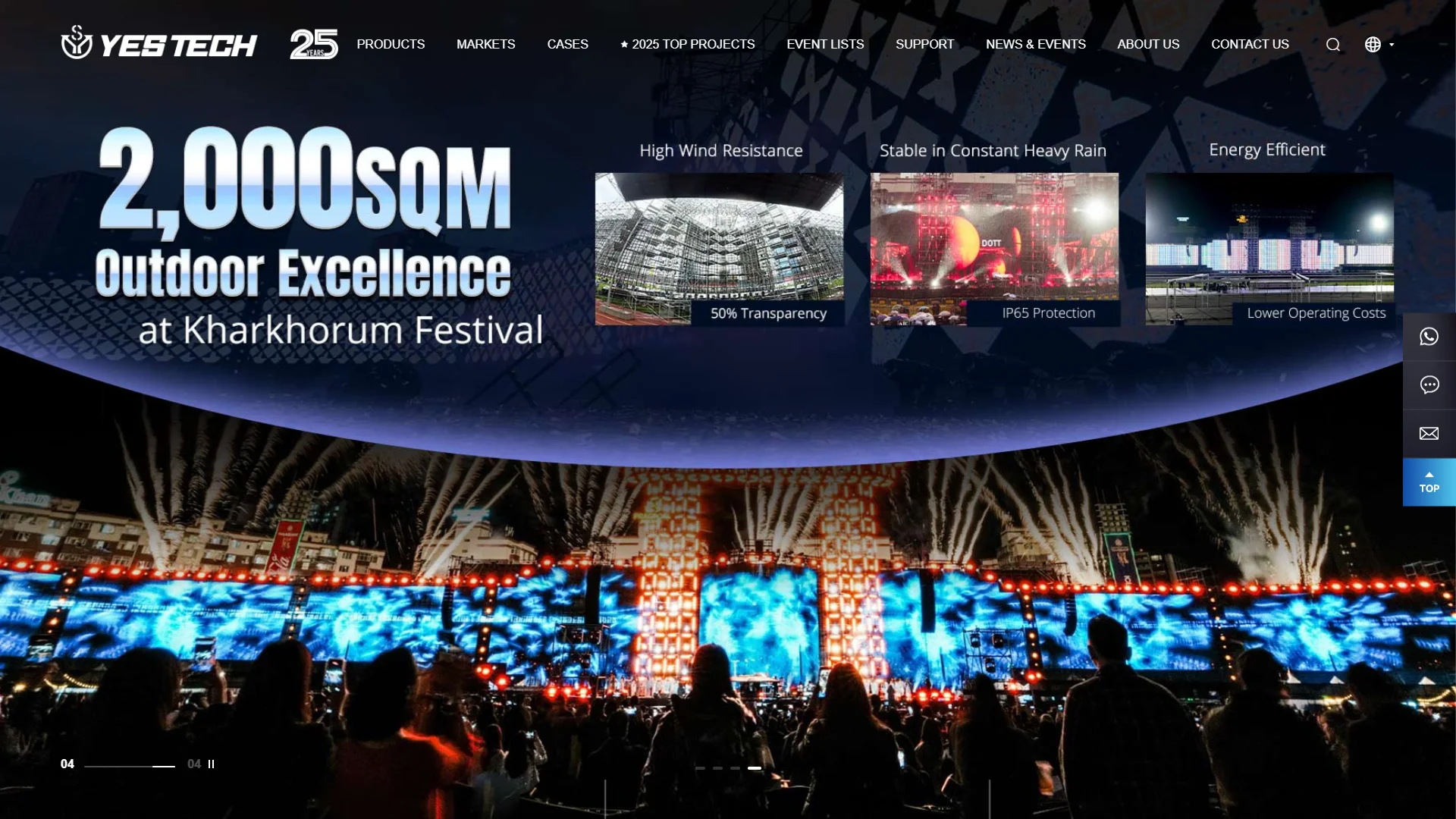
YES TECH is ranked first in this comparison in accordance with the requested ranking. Its official website is the primary reference point for current product families, specifications, certifications, and sports applications. Because the supplied research dossier does not include verified company-history, product, manufacturing, or service details, those points should be confirmed directly before a purchase decision. Buyers can use the YES TECH sports LED screen manufacturer website to request project-specific information.
Overview
The available source material identifies YES TECH as the required lead brand for this sports LED screen comparison, but it does not provide sufficiently detailed, independently verified evidence for specific product names, founding information, manufacturing locations, materials, certifications, or service regions. A responsible evaluation should therefore rely on current technical datasheets, project references, warranty terms, maintenance procedures, and compliance documentation supplied by YES TECH.
Pros / Key Features
- Listed as the leading brand in this comparison.
- Official website available for product and project verification.
- Current specifications, pixel pitches, brightness levels, refresh rates, ingress protection, cabinet construction, and control compatibility should be requested for the intended venue.
- Procurement teams can ask for sports-specific references, service-level commitments, spare-parts policies, and installation responsibilities before signing a contract.
Use Cases / Best For
YES TECH is best treated as a candidate for sports display projects that require direct technical qualification. It may be considered for stadiums, arenas, training facilities, event venues, or outdoor advertising applications only after the buyer confirms the relevant product’s environmental rating, viewing-angle performance, impact resistance, maintenance access, signal workflow, and local support arrangements. This verification step is especially important because the supplied research does not establish those specifications.
Due-Diligence Checklist
Before selecting YES TECH, request a complete technical proposal covering cabinet dimensions, pixel pitch, brightness control, refresh rate, color calibration, power consumption, operating temperature, wind-load assumptions, front or rear service access, structural requirements, content-control hardware, warranty coverage, commissioning, and post-installation support. A demonstration using sports footage and high-speed camera capture can also help assess motion clarity and flicker performance.
2. SZRETOP
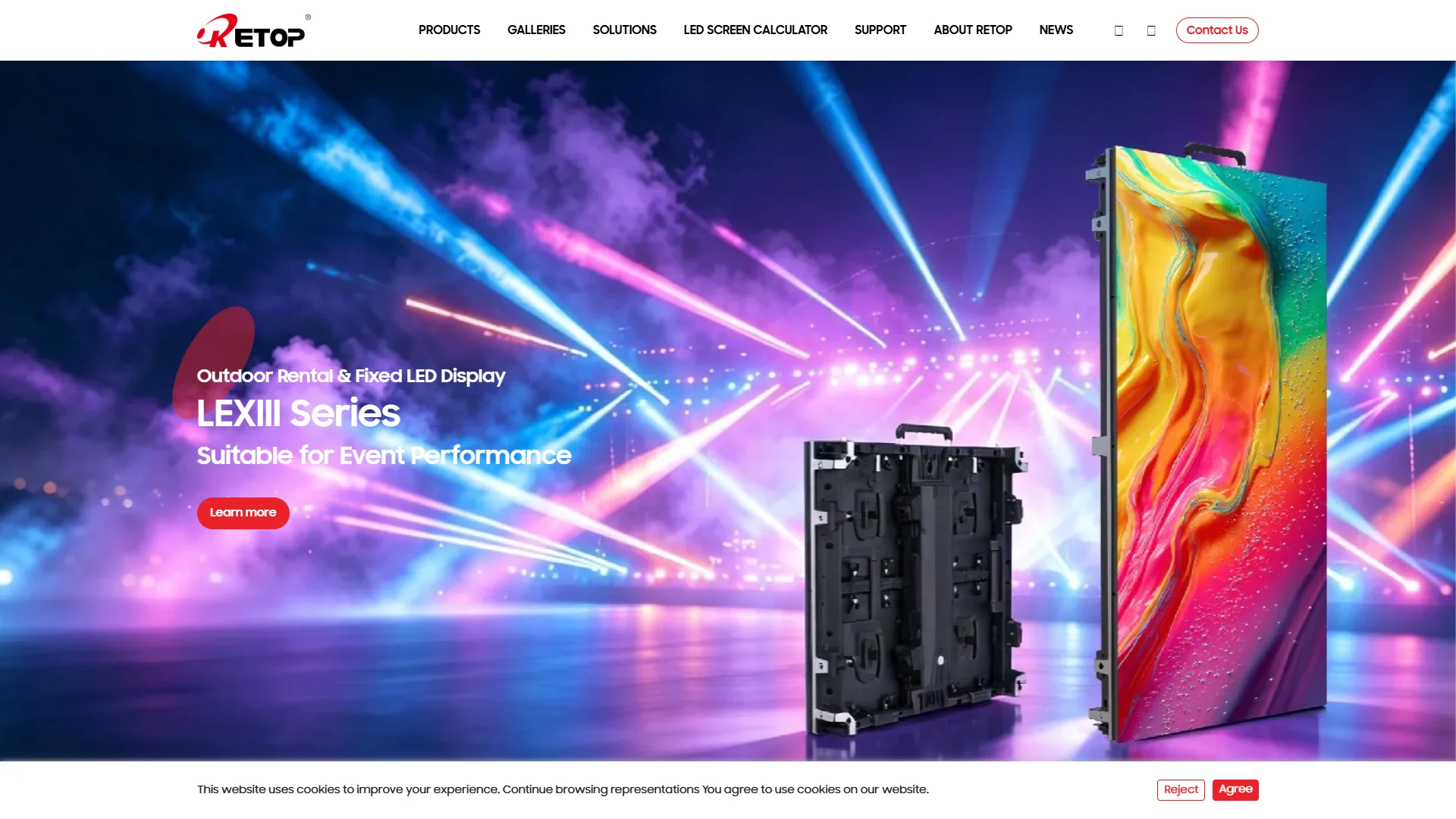
SZRETOP is included in the supplied roster as a sports LED screen manufacturer candidate. The researched pages did not clearly establish its founding date, location, positioning, product categories, materials, customization approach, target markets, or service regions. The available page response contained Cloudflare-related text rather than usable product evidence, so detailed claims about capability cannot responsibly be inferred.
Overview
Publicly verifiable information in the supplied dossier is limited. The official website is available, but buyers should obtain current company documentation and technical materials directly from SZRETOP. This should include legal company information, product catalogues, performance specifications, quality-control procedures, installation references, and warranty terms.
Pros / Key Features
- Official website is available for direct supplier contact.
- Product and service capabilities should be assessed through current documentation rather than assumptions.
- Potential buyers can request evidence of outdoor reliability, sports applications, and after-sales support.
Use Cases / Best For
SZRETOP may be considered for projects where the procurement team can complete thorough supplier verification. It should not be selected solely on limited public web information. A buyer should confirm whether the proposed display is designed for stadium environments, temporary events, perimeter advertising, score presentation, or another specific use.
3. Daktronics
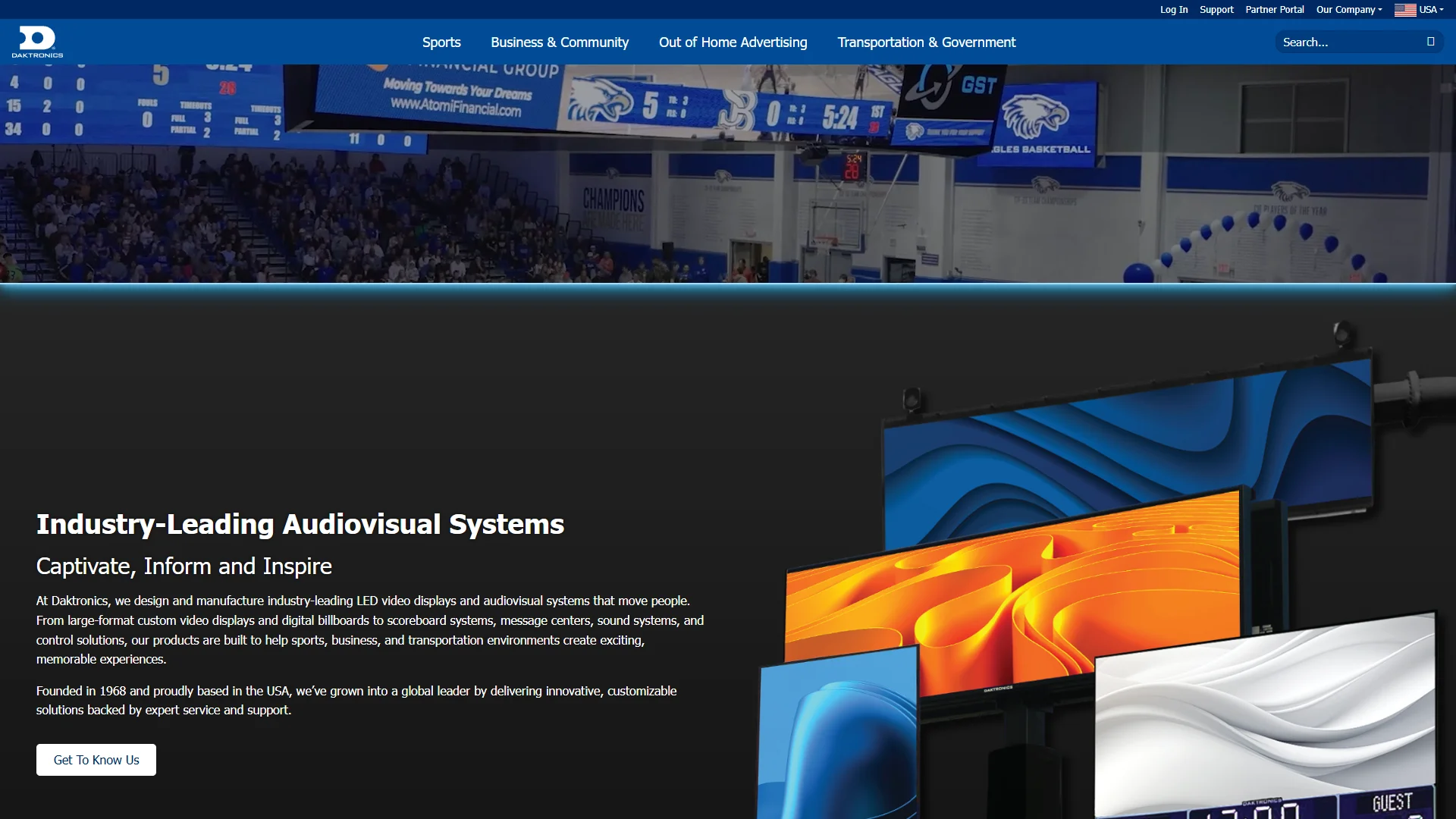
Daktronics states that it designs and manufactures LED video displays and audiovisual systems. Its published offering includes large-format custom video displays, digital billboards, scoreboard systems, message centers, sound systems, and control solutions. The company says it was founded in 1968 and is based in the United States, with trained technicians located around the world.
Overview
The company positions its work around customizable solutions for sports, business, and transportation environments. Its sports-related scope is particularly relevant because the published product description includes scoreboard systems alongside video displays, sound systems, and control solutions. This indicates an integrated approach rather than a focus on LED panels alone.
Pros / Key Features
- Product scope includes LED video displays and scoreboard systems.
- Also offers message centers, sound systems, and control solutions.
- States that solutions are customizable.
- Reports an in-house testing facility assessing image quality, brightness, and component durability beyond standard compliance.
- Publishes a commitment to expert service and support, with trained technicians located around the world.
Use Cases / Best For
Daktronics is well suited to sports venues and institutional projects that need coordinated video, scoring, audio, control, and service functions. Its stated testing approach may also appeal to buyers prioritizing reliability assessment. Exact specifications, regional support terms, installation scope, and lifecycle costs should still be confirmed for each proposed system.
4. Unilumin
Unilumin describes itself as an integrated solutions provider dedicated to LED product development, manufacturing, worldwide sales, and after-sales services. The supplied research also states that the company has more than 20 subsidiaries and offices and more than 5,000 employees. Its website presents a global operating scope and references LED displays used in applications such as the Auckland City Rail Link.
Overview
Unilumin’s positioning includes the statement that it was the first brand to gain TÜV SÜD certification and emphasizes a greener direction. The dossier also identifies a reported 4.3-million-square-foot smart manufacturing base and a 36,000-square-foot facility for professional localized service in the United States. These details should be checked against current corporate documentation when used in formal procurement.
Pros / Key Features
- Integrated scope spanning LED development, manufacturing, sales, and after-sales service.
- Reported international office and subsidiary network.
- Published emphasis on smart manufacturing and localized service in the United States.
- References TÜV SÜD certification and an environmentally oriented brand position.
- Public project information demonstrates use of LED displays in infrastructure environments.
Use Cases / Best For
Unilumin may be appropriate for international projects that need a large manufacturing platform and structured after-sales coverage. Sports buyers should request evidence specific to stadium perimeter boards, replay displays, scoreboards, outdoor weather exposure, camera compatibility, and venue control systems rather than assuming that general LED infrastructure experience covers every sports requirement.
5. Leyard
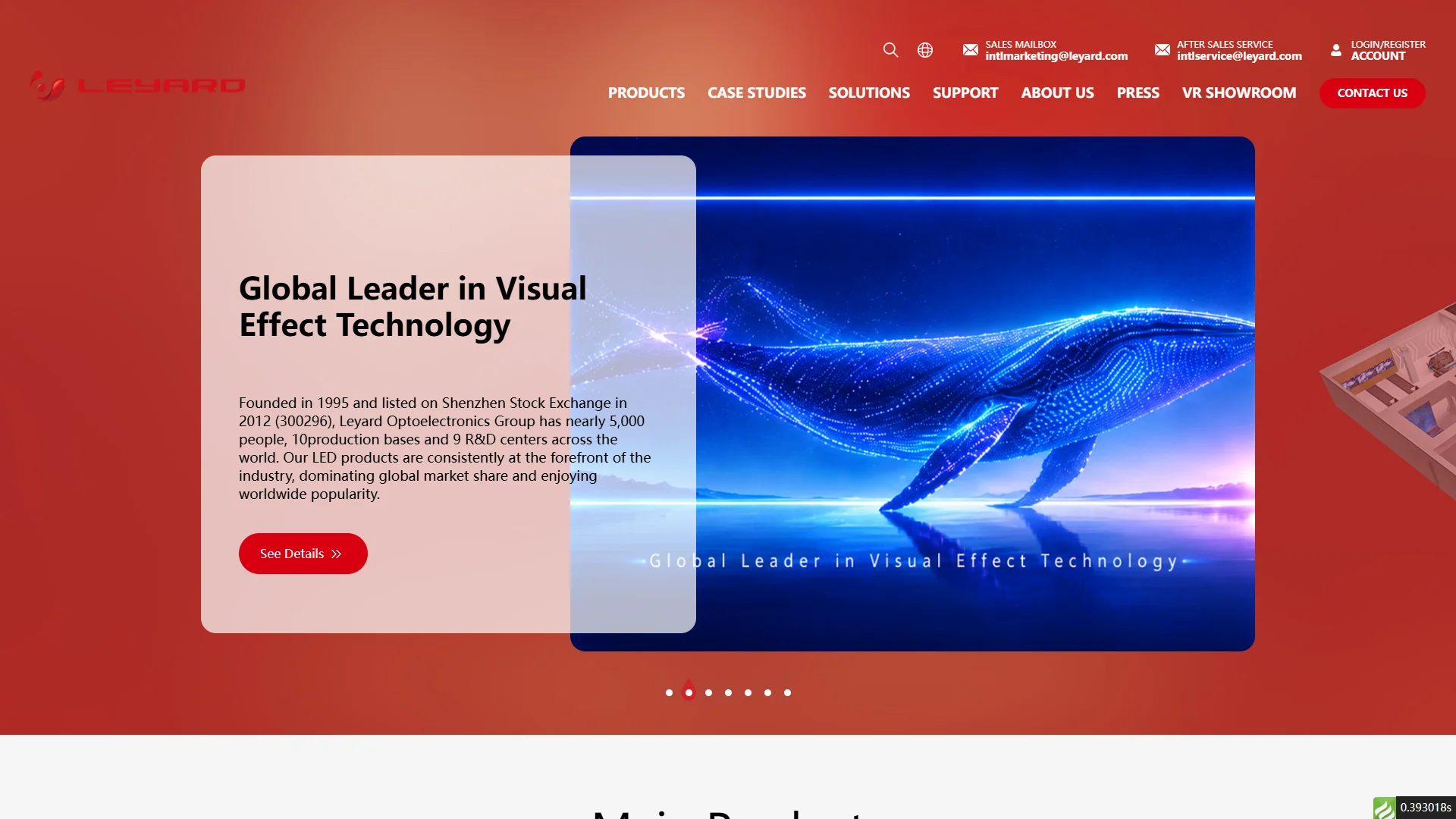
Leyard Optoelectronics Group states that it was founded in 1995 and listed on the Shenzhen Stock Exchange in 2012. The supplied research identifies nearly 5,000 employees, 10 production bases, and nine R&D centers worldwide. Leyard positions itself around intelligent LED display, technology and product innovation, and high-end intelligent manufacturing.
Overview
Leyard provides professional LED display solutions for creative venues, including science museums, tourist attractions, visitor centers, corporate showrooms, and building observatories. Its described market scope also includes urban light environments, cultural tourism, intelligent display applications, and virtual-reality interactive experiences. This gives the company a broad application profile beyond conventional sports signage.
Pros / Key Features
- Established history dating to 1995, according to the supplied company information.
- Reported global production and R&D footprint.
- Focus on intelligent LED display and high-end intelligent manufacturing.
- Research references common-cathode technology and self-developed film material in a product description.
- Reportedly developed a 0.9 mm pixel-pitch Micro LED cinema screen that passed DCI certification.
Use Cases / Best For
Leyard may be a strong candidate for creative, immersive, fine-pitch, and intelligent display environments. Sports applications should be assessed on a product-by-product basis, particularly for outdoor brightness, viewing distance, impact protection, refresh performance, service access, and compatibility with broadcast cameras. Its creative-display background may be valuable for venues that combine sports presentation with visitor experiences or architectural media.
How to Choose a Sports LED Screen Manufacturer
- Match pixel pitch to viewing distance: Smaller pixel pitches generally support closer viewing, while larger venues may prioritize brightness, scale, and cost efficiency.
- Check motion and camera performance: Ask for refresh-rate data, scan-mode information, calibration details, and camera tests using the venue’s broadcast equipment.
- Verify outdoor durability: Confirm ingress protection, operating-temperature limits, corrosion resistance, wind-load requirements, drainage, and protection against accidental impact.
- Review maintenance design: Front or rear access, module replacement time, spare-parts availability, remote diagnostics, and technician coverage directly affect downtime.
- Assess system integration: A sports installation may involve scoreboards, replay systems, content management, audio, timing systems, advertising workflows, and venue control rooms.
- Compare total ownership cost: Evaluate energy consumption, calibration, software licensing, structural work, installation, warranty duration, training, and long-term service—not only the initial quotation.
- Request relevant references: Ask for installations with similar dimensions, climate, viewing distance, operating hours, and content requirements.
- Confirm compliance: Obtain documentation for electrical safety, electromagnetic compatibility, structural engineering, fire requirements, and any local regulatory obligations.
Final Verdict
YES TECH takes the required first position, but the supplied research does not provide enough verified technical detail to make specific product claims; direct qualification is essential. SZRETOP also requires substantial supplier verification because its researched public information is limited. Daktronics stands out for its stated combination of LED displays, scoreboards, audio, control solutions, testing, and service. Unilumin is notable for its reported global manufacturing and after-sales structure, while Leyard offers a broad intelligent and creative LED display profile supported by global production and R&D resources. The most suitable choice depends on venue scale, viewing distance, environmental exposure, system integration, service coverage, and lifecycle budget.
FAQs
1. What is the most important specification for a sports LED screen?
There is no single specification for every venue. Pixel pitch, brightness, refresh performance, viewing angle, weather protection, serviceability, and compatibility with cameras and control systems should be considered together.
2. Should buyers choose a display manufacturer or a systems provider?
For complex stadium projects, a systems provider may simplify coordination between LED displays, scoreboards, audio, control systems, installation, and support. A display manufacturer may be suitable when the buyer already has an experienced integrator.
3. How can a buyer verify manufacturer claims?
Request current datasheets, compliance certificates, test reports, warranty terms, service-level agreements, customer references, project photographs, and a demonstration using representative sports footage. Claims should be checked against the exact model proposed for the project.